
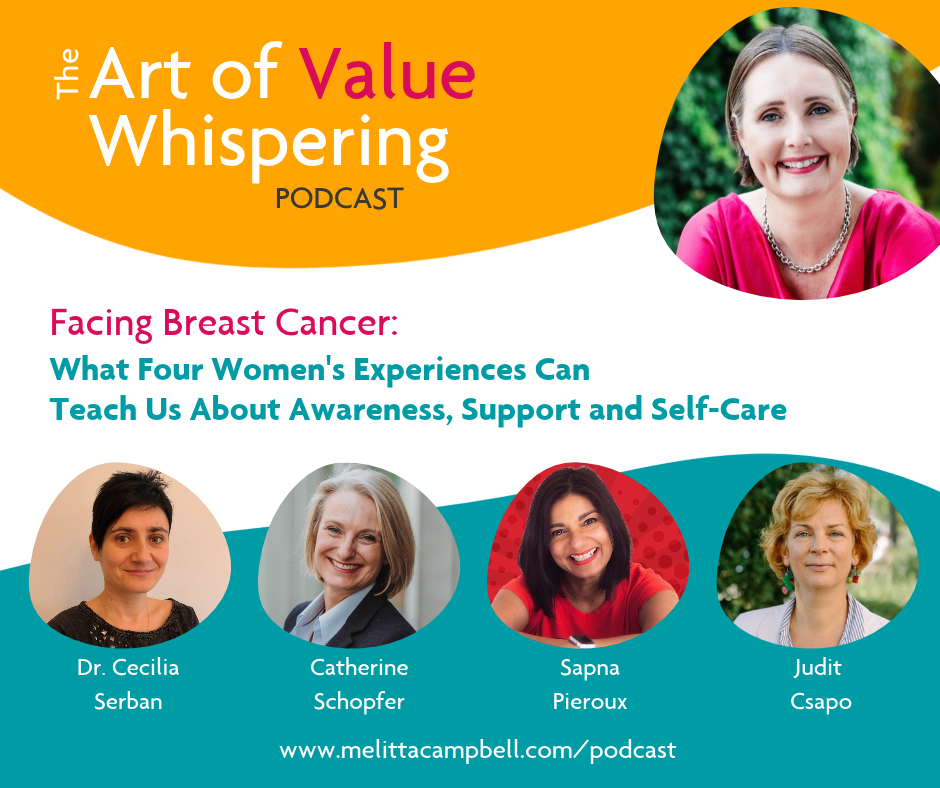


Facing Breast Cancer: What Four Women's Experiences Can Teach Us About Awareness, Support and Self-Care
An honest and empowering conversation about breast cancer, recognising changes in your body, navigating a diagnosis and finding the support you need.
There are some conversations that stay with you long after you've had them.
And sometimes, you don't realise just how valuable those conversations will become until life takes an unexpected turn.
Four years ago, I brought together four remarkable women for a special podcast conversation about breast cancer. My intention was to share their experiences, knowledge and perspectives to help other women feel more informed, supported and empowered.
At the time, I had no idea just how important that conversation would become to me personally.
Because a few weeks ago, I found a lump in my breast.
What followed was a whirlwind of appointments, scans, biopsies and more appointments. And around three weeks after first discovering that lump, I received a diagnosis of triple-negative breast cancer.
It's an aggressive form of breast cancer that requires intensive treatment. Thankfully, we caught it early, and my medical team has given me a positive outlook.
As I write this, I'm preparing to begin chemotherapy.
It's certainly not the journey I had planned. But one thing that has helped me enormously is the knowledge and perspective I gained from that original conversation.
And that's why, during Breast Cancer Awareness Month, I wanted to revisit it and share its wisdom with you.
Whether you're navigating a diagnosis yourself, supporting someone you love, or simply wanting to become more aware of your own breast health, I hope you'll find something here that helps you.
“When you’re self-full, you have the energy, perspective and wellbeing to give your best to the people around you.” - Melitta Campbell
Prefer to WATCH?
Breast awareness is about knowing what's normal for you
One of the most important messages from our conversation came from Sapna, a branding expert and business owner who had recently undergone treatment for breast cancer.
Sapna's story is particularly powerful because she didn't discover a traditional lump.
Instead, she noticed a subtle change in the texture of her breast while applying body lotion after her shower.
It was such a small difference that she initially wondered whether it was simply the result of exercising more.
But something didn't feel quite right.
She already had a mammogram booked for several weeks later and initially thought she could wait until then.
Thankfully, a friend encouraged her to make an appointment sooner.
That decision proved important.
Her experience reminds us that breast awareness isn't simply about looking for lumps. It's about becoming familiar with your own body so that you can recognise when something changes.
This message has become particularly meaningful to me because finding and pointing out my own lump was what started the process that led to my diagnosis. A mammogram, ultrasound and expert check didn’t find the lump!
My experience also reminded me how important it is to speak up when something doesn't feel right, even when an examination or scan hasn't provided all the answers.
The important thing is not to become frightened of every change, but to become confident enough to notice it and seek medical advice.
Get to know what's normal for your breasts. And if you notice something different, please don't ignore it.
You don't have to navigate a diagnosis alone
One of the things that struck me throughout our panel conversation was how differently each woman experienced breast cancer.
There was no single correct way to respond.
Some found strength in talking openly about their diagnosis. Others needed more privacy or wanted to choose carefully what they shared and with whom.
Sapna spoke about her decision to involve her two sons early in the process.
She wanted them to understand what was happening rather than feel that something important was being hidden from them.
It wasn't necessarily an easy decision, and she received different opinions about whether she had done the right thing.
But for her family, openness helped build trust.
I think there's something very valuable in that.
When we're facing something difficult, it's natural to want to protect the people we love. Yet sometimes, allowing them into our experience gives them an opportunity to understand, support and connect with us.
Of course, every family is different.
You get to decide what feels right for you, what you want to share and when you're ready to share it.
The important thing is recognising that you don't have to carry everything by yourself.
Your diagnosis is something you're experiencing. It isn't everything you are.
One of the most moving parts of the conversation was hearing how a cancer diagnosis can change the way other people see and respond to you.
One of our panellists described noticing that, when she told people she had breast cancer, their attention immediately shifted towards her breasts.
She wanted people to remember that she was still the same person.
I found that incredibly powerful.
Because when someone receives a serious diagnosis, it's easy for the illness to become the centre of every conversation.
Suddenly, people are asking about appointments, treatment, symptoms and results.
And while those questions often come from a place of genuine care, the person behind the diagnosis can sometimes get a little lost.
We are still ourselves.
We still have our personalities, our interests, our relationships, our ambitions and our sense of humour.
We still want to talk about ordinary things, laugh with friends and enjoy life.
For me, that's something I'm determined to hold on to throughout my own treatment - my sense of joy and purpose.
Yes, I'm going through breast cancer. But there's still so much more to my life than that.
And I don't want to lose sight of it.
The way we think about a challenge can influence how we experience it
If you've followed my work for a while, you'll know that I'm a big believer in the power of reframing.
Not because changing our thoughts magically changes our circumstances.
But because the language we use and the meaning we give to an experience can influence how we approach it.
Throughout our conversation, the women shared how their perspectives evolved during and after treatment.
There were moments of fear, uncertainty and physical exhaustion. But there were also moments of gratitude, connection, learning and personal growth.
That doesn't mean every difficult experience needs to become a positive one.
And it certainly doesn't mean we have to feel cheerful all the time.
It's perfectly natural to feel frightened, frustrated, sad or overwhelmed.
But I've found it helpful to ask myself whether there's another way to look at what lies ahead.
Which is why I've decided to approach the coming months as my Radical Wellbeing Retreat.
Admittedly, it's a rather extreme retreat, and some of the treatments leave a lot to be desired!
But rather than spending the next six months thinking only about cancer treatment, I want to focus on giving my body and mind the care, rest and attention they need.
I'm incredibly grateful for the medical team supporting me, the treatment available to me and the wonderful people around me.
I'm not pretending this will be easy.
In fact, the thought of losing my hair has brought more tears than almost anything else so far.
But I'm gradually finding a different perspective on that, too.
And for now, this feels like a more empowering way for me to approach the journey.
Self-care isn't a luxury, especially when life becomes demanding
Another important theme running through our panel conversation was the role of self-care.
Our panellists explored the emotional and practical demands of treatment, including the importance of rest, nourishment, managing stress and recognising when we need additional support.
What I particularly appreciated was the reminder that everyone's circumstances are different.
Some women can step away from work during treatment. Others need to continue working because of financial responsibilities, family commitments or personal circumstances.
There isn't one right way to manage it.
And I think that's an important message for the business owners and professionals in our community.
Many of us are very good at looking after everyone else.
We support our clients, manage our businesses, care for our families and keep all the plates spinning.
But how often do we stop to ask what we need?
Sometimes, caring for ourselves means resting.
Sometimes, it means asking for help, changing our schedule, setting a boundary or allowing someone else to take responsibility for something.
And sometimes, it means recognising that the way we've always done things may not be the way we need to do them right now.
Self-care isn't about getting everything right.
It's about listening to what we need and responding with kindness.
And, importantly, it should support the medical care we need, not replace it.
Asking questions can help you feel more involved in your care
One of the most practical insights from our panel came from the medical perspective.
Our surgeon, Dr Cecilia Serban, highlighted how valuable it can be when patients ask what they can do to support themselves alongside their treatment.
I loved this because it shifts us from feeling that everything is simply happening to us towards recognising that we can participate in decisions about our care.
That might mean asking questions about treatment options, understanding possible side effects, discussing how to manage symptoms or exploring what support is available.
It can also mean asking for clarification when something doesn't make sense.
You don't need to understand every medical term or have all the answers.
That's what your healthcare team is there to help you with.
But you can take an active role by being curious, asking questions and making sure your concerns are heard.
I've certainly found that understanding what's happening and why has helped me feel more confident as I prepare for treatment.
And when so much feels uncertain, that sense of understanding can be incredibly reassuring.
Sometimes the most valuable support is simply being there
One of the things I've been reflecting on since my diagnosis is the extraordinary value of the relationships we build over time.
Friends, family, colleagues, collaborators and trusted experts can all become part of our support network.
And we don't always know when those relationships will become especially important.
Our panel conversation included thoughtful reflections on how to support someone with cancer.
One particularly important message was to resist the temptation to immediately offer advice.
When someone shares a diagnosis, we naturally want to help.
We may want to share a story we've heard, suggest something they could try or reassure them that everything will be fine.
But sometimes, what someone needs most is simply to be heard.
To be treated as the person they've always been.
To know that you're there without feeling they have to explain, reassure or manage your emotions as well as their own.
A gentle offer of practical help can often be more useful than a long list of suggestions.
And, of course, it's worth remembering that the support someone needs may change from one day to the next.
We don't always have to find the perfect words. Sometimes, our presence is enough.
We don't always know when the value of an experience will become clear
There's one final reflection I want to share.
When I originally organised this panel, I was thinking about the women who might benefit from hearing it.
I wanted to bring together different experiences and perspectives, to create a conversation that would help people feel more informed and less alone.
I never imagined that I would one day be listening to it as someone preparing for breast cancer treatment herself.
And yet, here we are.
The stories, insights and encouragement these women shared have given me so much to draw upon.
They've helped me ask better questions, understand different possibilities and approach my own journey with greater confidence.
And they've reminded me of something I believe deeply.
The value we create through sharing our knowledge, experiences and perspectives isn't always immediately visible.
Sometimes, something we say today becomes exactly what someone needs to hear years later.
That's one of the reasons I love bringing people together through this podcast.
We each have experiences and insights that may help someone else see a situation differently, feel more understood or take an important step forward.
And we don't always know how far that value will travel.
A final thought: Please listen to your body
If there's one thing I'd love you to take away from this conversation, it's the importance of paying attention to your own health.
Get to know what's normal for your breasts.
Don't assume every change will be a lump.
And if something feels different, please get it checked.
You don't need to wait until you're certain something is wrong before asking a healthcare professional for advice.
And if you or someone you love is navigating breast cancer, I hope this conversation reminds you that there are people, resources and support available to help you through it.
You don't have to know exactly how you're going to manage everything from the beginning.
You can take things one step at a time.
As for me, I'm heading into my Radical Wellbeing Retreat with gratitude, a wonderful team around me and a determination to keep finding moments of joy along the way.
Thank you for being part of this community, and for allowing me to share this very personal chapter with you.
Take good care of yourself, and the people you love.
With love,
Melitta
Please note: This article shares personal experiences and perspectives, not individual medical advice. Always speak with your healthcare team about any concerns, symptoms or treatment decisions.
Listen Next
Continue with Episode 320 — Struggling to Find Your Niche? You May Be Starting in the Wrong Place
If niching has ever felt restrictive or confusing, this episode will help you see it differently. Discover why finding your niche starts with understanding your own expertise, strengths and approach – rather than simply choosing a target market.
About Your Host, Melitta Campbell
Melitta Campbell is the creator of the Value Whispering® methodology, a 3x bestselling author, TEDx speaker and an award-winning communications and marketing expert with more than 30 years' experience helping organisations, leaders and service-based experts communicate their value more clearly.
Through her books, keynote talks, coaching and this podcast, she challenges conventional marketing wisdom and helps experts become the obvious choice through smarter - not louder - marketing.
Her work is built on one simple belief:
People don't choose the best expert.
They choose the one whose value they understand best.
Learn more about working with Melitta here
Connect with Melitta

Get your best priced Atomicon tickets here >

6 Steps to More Dream Clients
Get the exact steps to building a PROFITABLE and MEANINGFUL business that lasts!
Get your 6-steps guide Now!
6 Steps to More Dream Clients
Get the exact steps to building a PROFITABLE and MEANINGFUL business that lasts!
Get your 6-steps guide Now!