
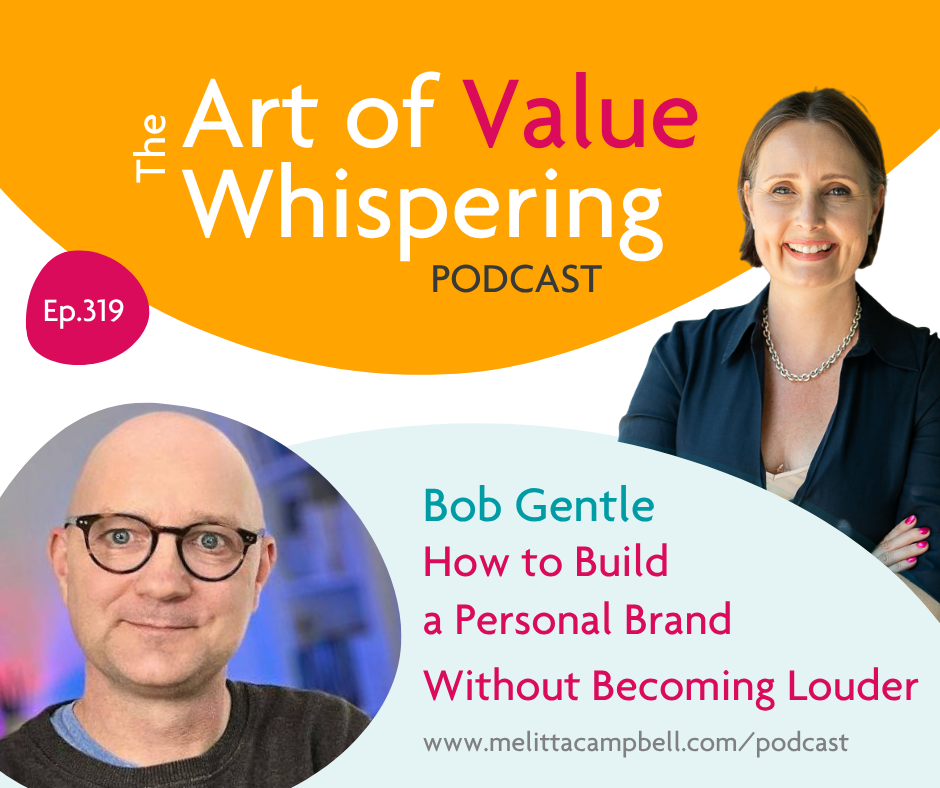



How to build a personal brand that creates trust, referrals and clients
Personal branding is often presented as a visibility game: post more, reach more people, become more noticeable. But visibility on its own does not make someone trust you, remember you or feel confident referring you.
For service-based experts, the more useful question is not simply, “How can I get seen?” It is: “How can I become known and trusted by the right people — without turning myself into a louder, more performative version of who I am?”
That is the territory I explore in this conversation with personal brand strategist Bob Gentle. Bob works with leaders, boards and CEOs to turn leadership visibility into influence, opportunity and revenue, and his perspective challenges several assumptions about what personal branding and content are actually for.
Our conversation moves from identity and generosity to trust, relationships, referrals and recall. Underneath it all is a simple idea: a strong personal brand is not something you perform. It is the recognisable experience of who you are, what you care about and the value you consistently bring.
Prefer to WATCH?
"I’m there to serve, not to convert." — Bob Gentle
Personal branding is an expression of identity, not a manufactured persona
One of the reasons personal branding can feel uncomfortable is that it is easy to assume you need to create a public version of yourself: more polished, more confident, more provocative or simply more like the people who already seem to be succeeding online.
Bob starts somewhere very different. For him, personal branding begins with paying attention to your identity: what motivates you, what you care about and what you stand for. When that foundation is clear, showing up online becomes less about inventing a persona and more about expressing something that is already true.
That matters because the person your marketing attracts is eventually going to meet the person behind it. If your visibility is built around a borrowed style or somebody else’s tactics, you risk attracting people who expect a version of you that doesn’t exist, or at least not in a way you can (or want to) sustain over the longer term.
Stop showing up to convert people
Bob offers a useful reframe for the traditional marketing funnel. Instead of treating the top of the funnel as a place to capture attention and begin moving people towards a sale, he thinks about it as mission: an opportunity to serve.
If somebody resonates with that mission, there may be a match. If the match is right and they have a problem Bob can help solve, a value exchange may follow. But the purpose of every piece of content is not to push somebody one step closer to buying.
That distinction changes the emotional experience of marketing. Showing up to persuade creates pressure. Showing up to be useful creates space to share what you genuinely know and care about. It also gives the right people repeated opportunities to experience how you think before they ever need to make a buying decision.
If you give away your best ideas, why would anyone pay you?
This is the question that often follows any conversation about generous marketing. If you answer people’s questions freely and share useful ideas, are you giving away the very thing you want them to buy?
Bob’s answer is trust. He argues that trust is not created by one impressive piece of content. It is built through small signals that compound over time: evidence of your thinking, your integrity and your ability to do the work.
He illustrates this with a 6,000-piece jigsaw puzzle. You can give somebody individual pieces and let them see how good the picture could be without handing them the completed puzzle. The expertise a client pays for is not simply access to isolated pieces of information. It is confidence in the bigger picture, the judgement to know what matters and the ability to put the pieces together in the right way.
As Bob puts it, people do not necessarily pay for information; they pay for implementation. And if someone can take what you have freely shared and solve the problem for themselves, they may never have needed to become your client in the first place.
Your network may matter more than your reach
Another important shift in the conversation is away from seeing personal branding purely as audience building. Bob has done hundreds of podcast interviews, but he does not treat those conversations as isolated moments of exposure. He sees them as relationships worth nurturing.
He describes networks as layers of coral: some relationships are active, while others have gradually slipped into long-term memory. His approach is to look backwards at relationships worth reactivating, pay attention to the relationships that are alive today, and look ahead to the people who may need to be around him for the future he wants to create.
This makes networking far more intentional. Rather than collecting contacts or constantly hunting for new prospects, the work becomes maintaining and deepening a network of meaningful relationships.
Content is not only there to attract strangers
This leads to one of my favourite parts of the conversation: Bob’s challenge to what he calls the myth of reach.
When people worry that LinkedIn is not giving them enough reach, Bob argues that they may be measuring the wrong thing. His content is not primarily designed to put him in front of as many strangers as possible. It helps him remain present in the minds of people who already know him.
“I’m not trying to go viral. I don’t care if I only get 200 views. What I care about is that that guy I met a year ago says, ‘Oh, that’s my friend Bob.’”
That is a very different job for content. It is not simply an acquisition tool. It can maintain recall, reinforce trust and keep a relationship warm between direct interactions. Over time, those repeated signals can make it much easier for someone to remember you when an opportunity, need or referral appears.
Let people know enough of you to trust you
Expertise matters, but people also need enough context to build a sense of the person behind it. Bob explores this through parasocial relationships: the feeling that we know somebody because we have encountered enough of their ideas, interests and personality over time.
His point is not that we need to turn our private lives into content. It is that a personal brand becomes more three-dimensional when people have enough genuine ‘raw material’ to understand how we think and who we are. If all we ever share is polished business information, there may be little for a human relationship to attach itself to.
I shared an example from my own networking: meeting someone who had followed me on LinkedIn and hearing her say, with delight, that I was exactly as she had imagined. That consistency created trust — and she later referred clients.
Consistency is bigger than a posting schedule
This is where the conversation touches something I think is easily missed in marketing advice. Consistency is not only about publishing at the same frequency or appearing online at a particular time.
There is another kind of consistency: being recognisably yourself. It is the consistency of your message, your values, the way you think and the way people feel when they interact with you.
When those signals align, every interaction can reinforce the last. Your content, conversations, referrals and client experience begin to build a more complete picture rather than presenting disconnected versions of you.
The Value Whispering perspective: recognition before reach
This conversation is a powerful illustration of an idea at the heart of Value Whispering®: recognition before reach.
Visibility matters, but more visibility does not automatically create more understanding. If people see you but do not understand what you value, how you think, what you are good at or why you are relevant to them, greater reach simply shows an unclear picture to more people.
Bob’s approach demonstrates the other side of the equation. Personal branding can help the right people recognise you, remember you and build confidence in you over time. The aim is not to persuade everyone. It is to make your value recognisable enough that the right person can think: this is someone I trust; this is someone I would refer; this is someone I want beside me when I am ready to solve this problem.
That is also why being yourself is not a soft alternative to strategy. It is part of the strategy. The more accurately your marketing reflects who you are and how you create value, the more likely you are to attract relationships you can actually sustain — and clients for whom your particular way of working genuinely matters.
A useful question to take away
Look at the content and marketing you are creating at the moment and ask:
Am I using this mainly to attract attention — or am I helping the right people recognise, remember and trust my value?
The answer may change what you create, who you create it for and how much pressure you put on every post to produce an immediate result.
About Bob Gentle
Bob Gentle is a personal brand strategist who works with leaders, boards, and CEOs to turn leadership visibility into influence, opportunity, and revenue.
With nearly 20 years in digital marketing, he helps senior leaders and experts articulate their leadership narrative, build authority, and monetise their personal brand in a way that supports organisational growth. He hosts the Building Your LeaderBrand Show, ranked in the global top 2% on ListenNotes.
Bob's resource
Free Personal Brand Business Roadmap: amplifyme.agency/roadmap
Connect with Bob
About Your Host, Melitta Campbell
Melitta Campbell is the creator of Value Whispering® and the host of The Art of Value Whispering Podcast.
An award-winning business strategist, TEDx speaker and 3x bestselling author, she helps experienced experts uncover the value they've become too close to see, communicate it with clarity, and build businesses that attract the right clients through trust rather than louder marketing.
Drawing on more than three decades in marketing and communications, Melitta shares a refreshingly different approach to business growth—one that helps experts recognise, own and express their value so they become the obvious choice for the clients they're here to serve.
Learn more about working with Melitta here
Connect with Melitta
Website Linkedin Substack YouTube
Enjoyed this? Listen to these episodes next →
There is one conversation I'd particularly recommend alongside this one:
#264 – Get a PhD in You: A Course in Miraculous Self-Discovery with Julie Reisler
If this conversation has left you wondering what it is about your own experience, expertise and perspective that makes you uniquely you, listen next to my conversation with Julie Riesler about getting a “PhD in you”.


6 Steps to More Dream Clients
Get the exact steps to building a PROFITABLE and MEANINGFUL business that lasts!
Get your 6-steps guide Now!
6 Steps to More Dream Clients
Get the exact steps to building a PROFITABLE and MEANINGFUL business that lasts!
Get your 6-steps guide Now!