
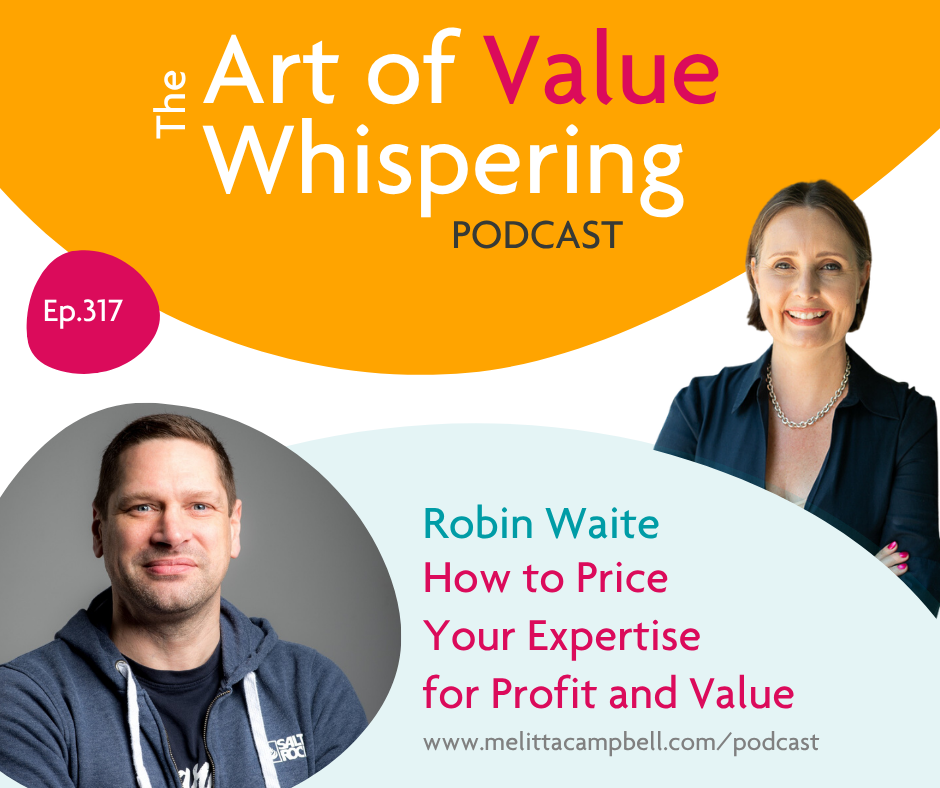



Are You Pricing Your Expertise for Profit – or Just to Win the Client?
If your business isn't as profitable as you'd like, your first instinct might be to find more clients by working on or investing in more visibility, more marketing and more conversations.
But what if more clients aren't the answer?
What if attracting more clients into a business that isn't sufficiently profitable simply gives you more work without solving the underlying problem?
That's one of the important questions I explored with business coach and Fearless Pricing author Robin Waite in our recent conversation on The Art of Value Whispering Podcast.
And while we talked about pricing, this conversation wasn't really about finding the magic number you should charge.
It was about something much more fundamental:
Understanding the value you create, packaging that value effectively, and pricing it in a way that allows both your clients and your business to thrive.
Because your pricing doesn't sit separately from your value.
It's part of how you communicate it.
Prefer to WATCH?
"People aren't paying for your time, they're not paying for the materials. They're paying for the results and outcomes which you deliver." — Robin Waite
More clients won't fix an unprofitable business
When business feels difficult, it's tempting to assume the solution is more marketing.
If only you could attract another five clients. Generate more leads. Get more people onto sales calls.
Then everything would be fine.
But Robin made an important point: if the clients you're already attracting aren't generating enough profit, adding more of them may simply compound the problem.
You're busier.
Your capacity disappears.
You have less time to think, improve your service or take care of your existing clients.
And you're still not making the money you need.
That's why I often encourage business owners to think in terms of less but better.
Fewer of the right clients. Better work. Better results. Better experiences. And a business model that supports you to keep doing your best work.
Because fair pricing isn't only about being fair to your clients.
It has to be fair to you too.
Stop selling your time and start packaging your value
One of the most common pricing challenges for coaches, consultants and other service-based experts is charging by the hour.
Sometimes we've technically stopped doing that – but we're still selling “packs” of five, ten or twelve sessions.
As Robin pointed out, that's really just a pack of hours.
The client is still being asked to buy your time rather than the result your expertise helps them create.
Robin suggests looking at your service through three questions:
- What is the outcome your client wants?
- Can you deliver that outcome over a defined period?
- Can you offer that transformation for a fixed fee?
That changes the conversation.
Instead of selling six months of your time, you're defining what those six months are designed to help someone achieve.
And that's an important Value Whispering distinction.
Your clients aren't ultimately choosing you because you can give them six calls, twelve sessions or twenty hours of consultancy.
They're choosing you because of what your expertise can help them change, solve or achieve.
Your job is to understand that value clearly enough to communicate and package it.
Can your business actually support the price you're charging?
Robin shared a wonderfully simple calculation that can expose a pricing problem very quickly.
- Start with the income you'd like your business to generate.
- Then look at the price of your core service.
- Divide one by the other.
How many clients would you need?
Imagine you'd like to generate £100,000 and you're selling a £1,000 coaching package.
You need 100 clients.
Now ask yourself:
Can I realistically attract 100 of the right clients?
And just as importantly:
Can I serve 100 clients brilliantly?
If the answer is no, you have useful information.
Now turn the calculation around.
If you realistically want to work with 20 clients, a £100,000 business requires an average client value of £5,000.
That doesn't necessarily mean you should jump from £1,000 to £5,000 tomorrow.
It does mean you can stop choosing your price based purely on what feels comfortable and start looking at what needs to be true for your business to become profitable and sustainable.
Higher prices need to be backed by greater value
There is plenty of advice telling business owners to “just double your prices”.
But I don't believe charging more simply because somebody told you to is particularly helpful. And neither does Robin.
If you're going to increase your prices, you need to be confident that the value is there.
The interesting part is that increasing your prices can actually give you more capacity to create that value.
When you're undercharging and overloaded, there isn't much space to step back and ask:
How could I make this better?
Where is my client getting stuck?
What's missing from their experience?
What small thing could I do that would make them feel particularly seen, understood or valued?
Robin calls these “moments of delight”.
In my own work, I think about where you can insert a little extra value – your way – throughout the client journey.
It doesn't necessarily require something expensive or elaborate. Sometimes it’s the 'Tiny Noticeable Things' (TNTs) you do differently that show your client how much you understand them and care, that can make the biggest difference.
Robin gave the example of recording a short, personal Loom video in response to applications for his coaching programme. It takes him a few minutes, but clients have specifically told him that personal touch influenced their decision to work with him.
That's Value Whispering in action.
You're not shouting louder about how wonderful you are.
You're allowing people to experience the difference for themselves, and come to their own conclusion about how wonderful it might be to work with you.
Your value starts before somebody becomes a client
This is an important point because we often think the “client experience” begins once someone has paid us.
It doesn't.
People are experiencing your business long before that.
For example, the way you respond to an enquiry, the questions you ask, how clearly you explain what you do, your application process and sales conversations … all of these things communicate something about your value.
Robin shared the example of an aesthetics business that stopped simply quoting its prices when people enquired and instead invited potential clients into the clinic for a consultation.
That gave people an opportunity to experience the quality and professionalism of the business rather than making their decision based on a number in a message.
The result was a significant improvement in conversion.
The lesson for an expert business isn't necessarily “remove your prices from your website”.
It's to ask a more useful question:
Does the journey I'm creating help the right people understand why my service is valuable before I'm asking them to make a decision about the price?
Before offering a discount, get curious
One of the most uncomfortable moments in a sales conversation can be hearing:
“That's too expensive.”
And when you really want the client, it's tempting to respond immediately with a discount or to jump into a long ramble to justify your price.
Robin's advice is much simpler.
Be quiet and give the other person space to think, because “that's expensive” doesn't necessarily mean “no”.
Often it’s a signal that your prospect …
Is working out how to afford it.
Is considering the value from the perspective of their situation.
Has a question that hasn’t yet been answered, or
Needs a moment to process what you've discussed.
I shared an experience where I gave a prospective client what felt like an extraordinarily long period of silence after sharing my price.
Eventually, she said yes. And afterwards, she thanked me for giving her the space she needed to think.
And together we took her business from low five figures (hence the long pause), to high six-figures in 18-months.
That experience changed the way I experienced those silences.
Instead of feeling I had to jump in and fill them, I could recognise that giving someone time was part of serving them well.
Your role isn't to persuade somebody into becoming a client.
It's to help the right person make the right decision for them.
“Too expensive” may not be a pricing objection at all
Robin estimates that only a small proportion of price objections are genuinely about the absolute price.
Sometimes someone simply doesn't have the money. That's real, and no clever sales technique changes it.
But often something else is happening.
For example, they might not have understood enough of the value yet, or they might not know whether the offer is right for their particular situation. Often they're worried whether they'll get the result they want. Or sometimes they may need a different payment structure rather than a lower price.
That's why curiosity is far more useful than defensiveness.
Therefore, rather than assuming you need to reduce the price, explore what's behind the concern.
Because if someone can't yet see the value, discounting doesn't solve the real problem.
Why discounting can cost more than you think
Discounts can feel harmless.
Take 10% off and surely you just need to sell 10% more to make up the difference?
As Robin explained, the maths doesn't necessarily work that way once margins and costs are taken into account.
His wider point is perhaps even more important for expert businesses.
Regular discounting can communicate something about your offer that you didn't intend.
Rather than signalling value and desirability, it can suggest excess capacity – we need to sell this, so we'll make it cheaper. That's very different from deliberately building a business around a smaller number of carefully chosen clients.
And the reverse can also be true.
A higher price can give you room to work with fewer people, serve them better and create greater profitability without continually chasing more volume.
That's a very different definition of business growth.
Don't let one “no” determine your pricing strategy
Raising your prices can feel deeply personal.
When you tell three people your new price, and one says it's too expensive, often we immediately think:
“I knew it. Nobody will pay this.”
Robin recommends a much more objective approach with what he calls 30/30/30.
Over 30 days, test your new pricing through around 30 conversations, and aim for roughly a 30% conversion rate.
The exact numbers are a benchmark, but the principle is powerful:
Don't turn one person's response into a universal truth about your value.
Gather evidence.
If almost everyone says yes, that can itself be useful pricing information - and it usually means your price is too low.
If nobody says yes, investigate what's happening. Is it the price, or is the offer not quite what people are looking for, or perhaps your value isn’t coming across clearly.
Give yourself enough information to make an informed decision rather than allowing one uncomfortable sales conversation to send you straight back to your old price.
Pricing confidence starts with value confidence
Towards the end of our conversation, Robin returned to the fear behind so many pricing decisions.
Fear of rejection.
Fear of being told we're too expensive.
Fear that perhaps we're not worth what we're asking.
And I think this is where pricing and Value Whispering intersect most clearly.
You don't become confident in your pricing by repeatedly telling yourself to “know your worth”. You become more confident when you understand the value of your expertise.
When you know who you help best.
When you're clear about the transformation you create.
When your offer has been designed around that transformation.
When your client experience reinforces what you promise.
And when you have evidence that the work you do matters.
Your price is part of how you communicate your value – but it can only do that effectively when the value behind it is clear, credible and consistently experienced.
That's why better pricing isn't simply about becoming more expensive.
It's about building a business where you can do exceptional work for the right people, be paid fairly for that work, and have the capacity to keep making the experience even better.
Because the goal isn't to become the most expensive expert.
And it isn't to become the busiest.
It's to build a thriving, sustainable business around work that creates genuine value – and to communicate that value clearly enough that the right clients can recognise it.
About Robin Waite
Robin Waite is a business coach and author of Fearless Pricing. After spending 12 years running a marketing agency, Robin moved into business coaching, where pricing became a recurring focus in his work with business owners.
His approach helps coaches, consultants and service-based businesses rethink how they package and price their expertise, with a focus on building profitable and sustainable businesses rather than simply attracting more clients.
Robin's resource
Robin has created an interactive online version of his Fearless Pricing book, with additional resources, at fearlesspricing.co.uk.
You can also find Fearless Pricing on Amazon.
Connect with Robin
About Your Host, Melitta Campbell
Melitta Campbell is the creator of Value Whispering® and the host of The Art of Value Whispering Podcast.
An award-winning business strategist, TEDx speaker and 3x bestselling author, she helps experienced experts uncover the value they've become too close to see, communicate it with clarity, and build businesses that attract the right clients through trust rather than louder marketing.
Drawing on more than three decades in marketing and communications, Melitta shares a refreshingly different approach to business growth—one that helps experts recognise, own and express their value so they become the obvious choice for the clients they're here to serve.
Learn more about working with Melitta here
Connect with Melitta
Website Linkedin Substack YouTube
Enjoyed this? Listen to these episodes next →
There are two conversations I'd particularly recommend alongside this one:
#206 – How to Price Fairly and for Profit with Janine Liston – The Pricing Lady
Continue the conversation about what ‘fair’ pricing really means – not just for your clients, but for you and the sustainability of your business.
#276 – Stop Competing on Price! (... and what to do instead) with David Gomez
Explore the other side of the equation: how to differentiate your business and communicate your value so that price doesn't have to be the deciding factor.


6 Steps to More Dream Clients
Get the exact steps to building a PROFITABLE and MEANINGFUL business that lasts!
Get your 6-steps guide Now!
6 Steps to More Dream Clients
Get the exact steps to building a PROFITABLE and MEANINGFUL business that lasts!
Get your 6-steps guide Now!