
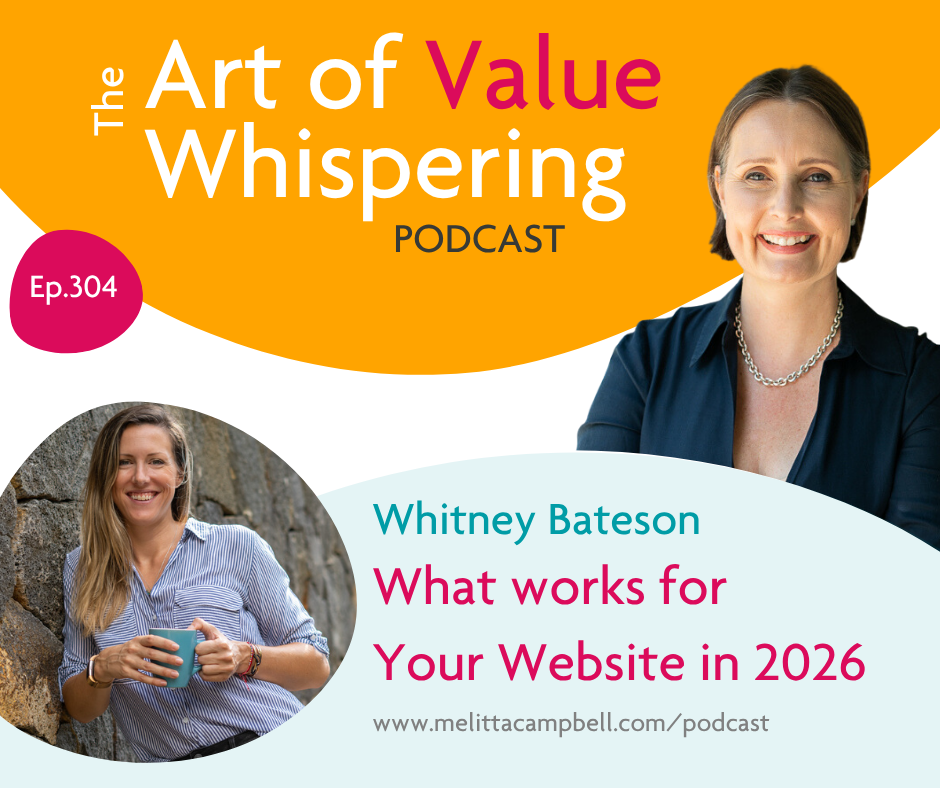


What works for Your Website in 2026
There is a lot of noise online right now.
More platforms. More content. More advice about what you “should” be doing to get visible, build trust, and attract clients.
It is no wonder so many business owners feel pulled in too many directions at once. Perhaps you can relate?
Amongst all that noise, your website can start to feel like an afterthought, or maybe even irrelevant. So while you want to create one, or update the site that’s been quietly sitting there waiting for your attention, with all the noise, hype and AI, perhaps you’re not quite sure of the right way to approach your website.
But your website still matters.
In fact, if you want to build trust, communicate your value clearly, and help the right people take that next step with confidence, it matters more than ever.
That’s why I invited Whitney Bateson onto the show to discuss what works best in 2026.
Whitney is a website strategist and marketing educator for health, wellbeing and coaching professionals. And in this episode, we explore what it really takes to create a website that works.
Not one that simply looks nice. But one that genuinely helps your dream clients feel seen, supported, and ready to move forward.
Whitney brings such a grounded and practical perspective to this topic.
Having started her career in nutrition before moving into marketing and website strategy, she understands deeply what it means to help thoughtful, service-led professionals translate their expertise into something clear, compelling, and easy for others to trust.
What stood out most in this conversation is how simply she brings it back to what actually matters:
Creating an online presence that reflects who you are.
Making it easier for the right people to understand how you can help.
And building trust in a way that feels natural, not forced.
“Trust is built online by helping your website visitors feel clear, feel heard, and feel safe.” — Whitney Bateson
Your website is not just a brochure
One of the most important shifts in this conversation is how Whitney reframes the role of a website.
So many people still treat it like an online leaflet. A place to list a few services, add a paragraph about themselves, and hope that is enough.
But your website is not just there to exist.
It is there to support a relationship.
For many people, your website is where that relationship begins to deepen. They may have found you through LinkedIn, heard you speak, listened to your podcast, or been referred by someone they trust. But before they get in touch, they usually go to your website.
And when they do, they are not only looking for information.
They are looking for reassurance.
They want to know if you understand them. If you can help. If your approach feels aligned to their needs, situation and values. And if taking the next step with you will feel safe, simpl, and worthwhile.
That is why your website matters so much. It is often the bridge between interest and action.
Why trust is built through clarity, not cleverness
Whitney speaks beautifully about trust, she brings it back to something very practical.
People trust what feels clear.
They trust what helps them feel heard.
They trust what reduces friction, rather than creating more of it.
That means your website does not need clever slogans or over-polished language. It needs words that resonate. Language that reflects what your clients are actually thinking, feeling, struggling with, and hoping for.
Because when someone lands on your website and reads something that sounds exactly like what has been circling in their head, something shifts.
They feel recognised.
And in a noisy online world, that feeling matters more than a perfect design ever will.
Whitney makes the point that people are unlikely to remember your website because of a shade of green they liked. What stays with them is the feeling of being understood.
That is such an important reminder.
Your personality is part of your value
When many people have similar qualifications, use similar tools, and support similar transformations, what often sets you apart is not a more complicated framework.
It is you.
Your story.
Your perspective.
Your personality.
Your way of seeing the problem.
Your way of helping people move through it.
That does not mean making your website all about you.
It means letting your personality come through enough that the right people can recognise themselves in your way of working.
Because your website is not just there to attract clients.
It is also there to filter them.
To help the right people think, “Yes, this feels like someone I could trust.” While letting those clients who don’t match your dream client criteria move on to someone who would be a better fit for their needs.
And sometimes that comes down to tone more than anything else.
Not sounding cold when you mean professional.
Not sounding generic when you mean clear.
Not sounding like everyone else when what you really want is to resonate deeper, not louder.
“If you read something that really resonates with you, that feeling sticks with you.” — Whitney Bateson
Ease is underrated, but powerful
We often spend so much time worrying about how to say things, how polished something looks, or whether our website feels impressive enough, that we forget one very simple question:
Is it easy for someone to take the next step?
If your website makes people work too hard to figure out how to contact you, book a call, understand your services, or know what happens next, you create doubt where there could have been momentum. And that causes people to click away from your site.
That does not mean your website needs to be pushy, however.
It means it needs to be clear and helpful.
If someone is ready to move forward, your job is not to make them hesitate. It is to guide them smoothly to the next step.
Whitney put this brilliantly when she shared the idea that without clear a call to action, you are simply warming people up for the competition.
That image really stays with you.
Because it is true.
If someone is interested, and your website does not make the next step obvious, they will likely go and find one that does.
Sales is not separate from service
This naturally led us into a conversation about sales.
And as always, I think this is where many thoughtful business owners get tangled.
They want to help. They care deeply. They want to be useful and genuine and human.
But the moment the word sales appears, everything tightens.
Yet sales done well rarely feels like ‘sales’, and so we don’t label it that way. Approached the right way, sales conversations feel like:
- Clarity
- Being listened to
- Being expertly guided
- Someone caring enough to help you understand what is possible and what the next right step might be.
That is exactly what your website can do.
It can create enough clarity and trust for someone to raise their hand and say, “Yes, I think this might be for me.”
And that is not pushy.
That is service.
If you know you can help someone, making it easier for them to find that support is part of the work.
Side note: For more on the right way to approach sales conversations, see Chapter 8 of my book ‘Value Whispering: The Smarter Way to Market Your Small Business’ for a complete step-by-step guide.
The clarity needs to come before the website
Another important thread in this episode is that websites work best when built on clarity.
Not panic. Not pressure. And not the feeling that “I have a business, so now I need a website immediately.”
Before you start building, you need to know:
Who is this for?
What do they need help with?
What makes your approach different?
What do you want them to do next?
How do you want the experience of your brand to feel?
Without that clarity, it is very easy to disappear into endless tweaking. Colours. Layouts. Fonts. Pages. Phrases.
All of which can feel productive, while quietly distracting you from the heart of the matter.
Whitney shares that one of the biggest things that slows people down is trying to build a website before they are clear on their services, message, and sales process.
And honestly, I see this all the time too.
Clarity is what gives your website substance.
Without it, even the prettiest design will struggle to do its job.
Your website is still an essential asset
We also touched on something many people are wondering right now.
With social media, AI, and so many other ways to be found online, does a website still matter?
The short answer is ‘Yes!’.
Your website is still the one place online where everything comes together.
It is where your story, your services, your testimonials, your thought leadership, and your next steps can live in one clear, intentional space.
It is also something you own.
Unlike social platforms, it cannot be taken away by an algorithm change or a locked account. It is your online home, and that matters.
And now, with AI tools increasingly drawing from websites to summarise, recommend, and refer service providers, the content on your website is doing even more work behind the scenes than most people realise.
So no, it has not become irrelevant.
If anything, it has become even more strategic.
“Your website is that place that builds trust with people. It cannot be replaced.” — Whitney Bateson
A quieter way to think about visibility
Perhaps my favourite thing about this conversation is that it reminds us that being visible does not mean being everywhere, all the time, shouting for attention.
Sometimes it looks like creating one strong foundation.
One clear message.
One website that reflects who you are and helps people understand how you can help.
That kind of visibility may be quieter, but extremely powerful.
Because it is built on authenticity, integrity and trust, not performance.
And when your website is doing that work well, it becomes more than a digital presence.
It becomes a calm, consistent part of your business growth.
A final thought to reflect on
If someone landed on your website today, would they feel clear, understood and confident about what to do next?
Or would they have to work too hard to connect the dots?
Your website does not need to be louder.
It needs to be clearer.
Because when people feel seen and safe, they are far more likely to take that next step.
And that is where real connection begins.
About Whitney Bateson
Whitney Bateson helps health and wellness professionals create strategic, trust-building websites that do more than look good.
After beginning her career in nutrition, Whitney moved into marketing and website strategy, bringing together her love of education, communication, and technology. Today, through her Wellness Pro Website System, she helps practitioners build websites that reflect their value, connect with the right clients, and support long-term business growth.
Her approach blends simplicity, strategy, and thoughtful teaching so that business owners are not just left with a website, but with the confidence to use it well.
💡 Ready to take action?
Download Whitney’s free guide: The 6 Essentials You Need on Your Website
Get your copy of: Value Whispering: The Smarter Way to Market Your Small Business
About Your Host, Melitta Campbell
Melitta Campbell is the creator of Value Whispering® and the host of The Art of Value Whispering Podcast.
An award-winning business strategist, TEDx speaker and 3x bestselling author, she helps experienced experts uncover the value they've become too close to see, communicate it with clarity, and build businesses that attract the right clients through trust rather than louder marketing.
Drawing on more than three decades in marketing and communications, Melitta shares a refreshingly different approach to business growth—one that helps experts recognise, own and express their value so they become the obvious choice for the clients they're here to serve.
Learn more about working with Melitta here
Connect with Melitta
Website Facebook Linkedin Twitter YouTube
You May Also Enjoy...
The Power of Confidence and Self-Belief
Why Laughter Connects ... and How To Use it for Business Success
Using Email to Grow Your Business

6 Steps to More Dream Clients
Get the exact steps to building a PROFITABLE and MEANINGFUL business that lasts!
Get your 6-steps guide Now!
6 Steps to More Dream Clients
Get the exact steps to building a PROFITABLE and MEANINGFUL business that lasts!
Get your 6-steps guide Now!